
On March 6, 2026, the California Department of Motor Vehicles was directed by the federal government to cancel approximately 13,000 non-domiciled commercial driver’s licenses. For most Californians, this read as a political story. For fleets, independent dealers, and small carriers who rely on affected drivers, it is a compliance problem — and if those vehicles are not handled correctly with DMV, it quickly becomes a registration problem too.
This article explains what actually happened, why parked trucks create suspended registrations, and what steps operators and fleet managers can take right now to protect themselves from a secondary wave of DMV complications.
What Happened on March 6, 2026
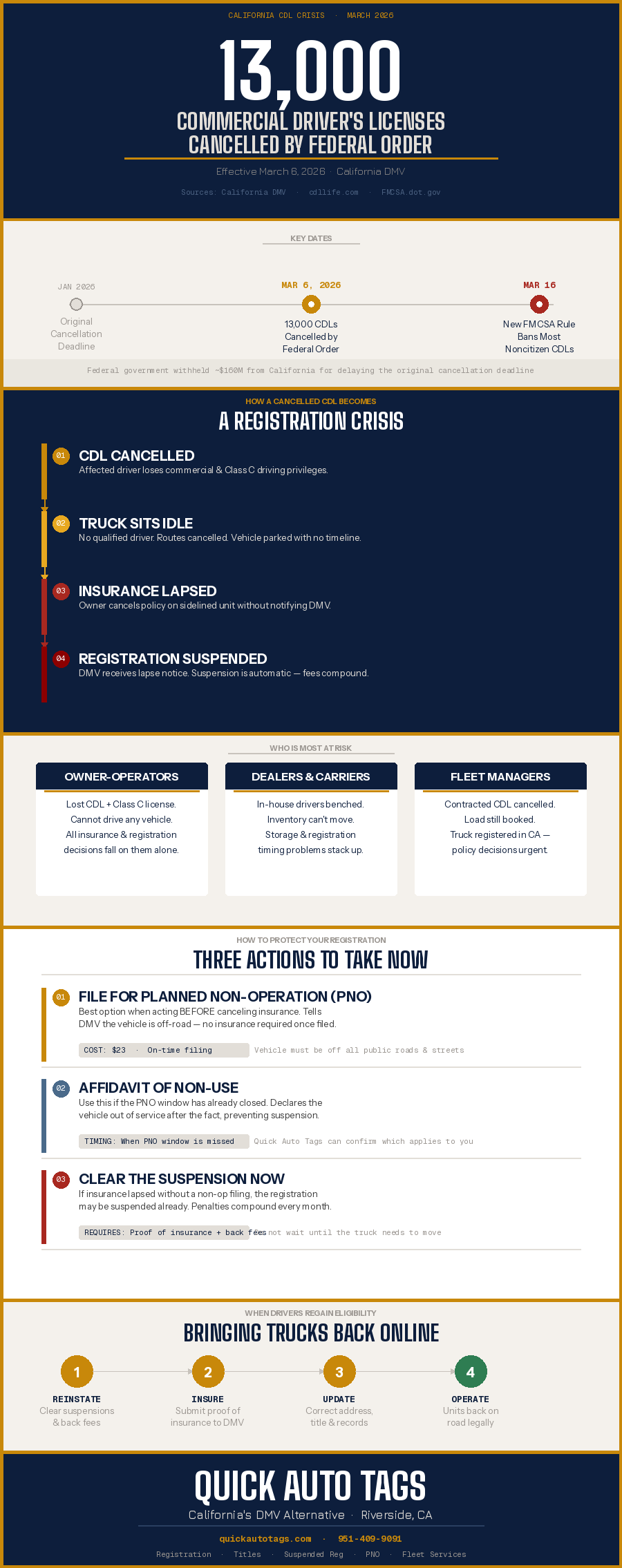
According to the California DMV, the federal government required the cancellation of approximately 13,000 non-domiciled CDLs effective that date. Non-domiciled drivers are individuals who are not U.S. citizens or lawful permanent residents but who had been granted federal work authorization at the time their licenses were issued. The DMV stated clearly that all affected drivers were legally present and work-authorized when the CDLs were originally issued.
The cancellations were not sudden. California had already pushed the original January 2026 deadline to March following a series of lawsuits filed on behalf of affected drivers. The U.S. Department of Transportation responded by withholding approximately $160 million in federal funding from California, citing the state’s failure to cancel the licenses on the original timeline. California eventually complied under that financial pressure.
Making the situation more complicated, a new FMCSA federal rule that effectively bans most noncitizens from obtaining CDLs took effect on March 16, 2026. Limited exceptions exist for certain agricultural and investor visa holders, but for most of the 13,000 affected drivers, the path back to a valid CDL is currently blocked at the federal level. Many affected drivers also lost their underlying Class C licenses, meaning they cannot legally drive any vehicle — commercial or personal — until they successfully reapply under the new rules.
How a Driver’s License Crisis Becomes a Registration Crisis
Most fleet operators and dealers understand what it means when a driver loses a CDL. What they do not always anticipate is what happens to the trucks those drivers operated.
When a commercial vehicle sits idle, the business decisions that follow — canceling insurance, pausing renewals, deferring plate fees — can each trigger a separate problem with DMV records. California law requires continuous liability insurance on any registered vehicle that is being operated on public roads. If a company cancels insurance on a sidelined unit without properly notifying DMV, that registration can be automatically suspended. And a suspended registration does not fix itself. Every month the vehicle sits, the backlog of penalties, fees, and reinstatement steps grows.
The mechanics are straightforward but easy to miss when you are dealing with route cancellations, driver reassignments, and shippers demanding answers. An operator cancels insurance on three trucks that no longer have drivers. DMV receives the electronic notice of the insurance lapse. If no non-operation status or affidavit of non-use has been filed, those registrations move into suspension. Six months later when a replacement driver is hired and the company tries to put the trucks back into service, they face suspended registrations, back fees, and the full reinstatement process before those vehicles can legally move.
Who This Situation Affects
Individual Affected Drivers
Drivers who held non-domiciled CDLs and have had them cancelled are currently in a difficult position with no guaranteed path to reapplication. Many are also without a Class C license in the interim, which means they cannot drive at all. If they owned the vehicle they operated — common in owner-operator arrangements — the registration and insurance decisions fall entirely on them. Filing for non-operation status before canceling insurance is the step that prevents an automatic suspension from compounding an already difficult situation.
Small Carriers and Independent Dealers
Independent dealers who use in-house drivers to move inventory between auctions, storage lots, and customer locations are vulnerable here. If any of those drivers are among the 13,000 affected, the dealer’s transport operation is disrupted immediately. Vehicles that cannot be moved may end up stored on-site longer than planned, which creates its own insurance and registration timing problems. Quick Auto Tags works with dealers across California to keep title and registration records clean, and that service becomes especially important when vehicles are sitting idle and ownership situations are shifting.
Fleet Managers with Contracted Drivers
Fleet managers who use third-party carriers or contractors face a different version of the same problem. A contracted driver’s CDL is cancelled. The load is still booked. The truck is registered in California and insured under a fleet policy. If the truck gets benched and the fleet decides to pull it from the policy, DMV needs to know — either through a non-operation filing or an affidavit of non-use — before the insurance cancellation processes. Fleet operators can reach the Quick Auto Tags team directly for help managing registration status across multiple units without letting any of them fall into suspension.
Keeping Your Paperwork Clean When Drivers Lose Their Licenses
The most important action an operator or fleet manager can take right now is to get ahead of any insurance cancellation before it hits DMV records.
File for Non-Operation Before Canceling Insurance
California’s Planned Non-Operation (PNO) status tells DMV that a vehicle will not be operated on public roads for the coming registration year. Once a PNO is filed, the DMV does not expect an active insurance policy on that vehicle, and an insurance cancellation will not trigger a suspension. The fee is minimal — $23 if filed on time — and it protects the registration from the moment it is processed. The catch is that the vehicle must come off public roads entirely. It cannot be parked on a street or in a public lot.
Use an Affidavit of Non-Use If the PNO Window Has Passed
If the registration renewal deadline has already passed and the PNO window has closed, an Affidavit of Non-Use may be the right tool. This is designed for situations where an operator needs to declare a vehicle out of service after the fact, and it can prevent a suspension from taking hold even when the timing is awkward. Quick Auto Tags can help determine which option applies to your specific situation.
Do Not Let a Suspension Build
If a vehicle has already moved into suspended registration status because insurance was cancelled before any non-operation filing was made, the time to act is now, not when you need the truck back on the road. Clearing a suspended registration in California involves submitting proof of insurance, paying back fees, and satisfying any other DMV holds — and the longer a suspension sits unresolved, the more those costs compound.
What to Do When a Driver Regains Eligibility
The CDL cancellations are tied up in active litigation and ongoing federal rulemaking. Some affected drivers may regain eligibility in the coming months if courts rule in their favor or if DMV is eventually permitted to reprocess applications. When that happens, operators who kept their registrations clean will be able to put trucks back into service with minimal friction. Operators who let registrations lapse or suspend will face a multi-step reinstatement process that adds days or weeks of downtime.
When you are ready to bring sidelined units back online, the steps are: reinstate the registration, clear any open suspensions, confirm proof of insurance is on file with DMV, and update the registration if any title or address changes occurred while the vehicle was benched. If the vehicle was moved out of state during this period or sold, there are out-of-state registration and title transfer processes to work through. Quick Auto Tags handles all of those steps without requiring you to visit a DMV office.
How Quick Auto Tags Can Help Right Now
The CDL cancellation crisis is a licensing issue at its core, but the ripple effects run directly into registration, insurance compliance, and DMV records. That is where Quick Auto Tags can step in.
Our team monitors DMV rulemaking and handles the registration side of exactly these kinds of situations — vehicles that are suddenly out of service, insurance policies being adjusted, registrations at risk of suspension, and fleets trying to get units back on the road quickly once the situation resolves.
Whether you need to file a PNO on a benched truck, clear a suspension that already happened, or work through a title transfer on a vehicle that is being sold or relocated while this plays out, we can move faster than a DMV office visit and handle the process from start to finish.
Renew or update your California registration with Quick Auto Tags, or call us directly at 951-409-9091 to talk through what your specific vehicles need right now.
