Expanded dismantler definitions, mandatory VIN-marking requirements, and strict recordkeeping rules now apply to anyone holding or selling catalytic converters
California’s aggressive response to catalytic converter theft has created new compliance landmines for car dealers and fleet managers who thought these laws only applied to recyclers and scrap yards. Two major pieces of legislation—AB 641 and SB 55—have fundamentally changed who needs dismantler licenses, what documentation is required to sell a vehicle, and how converter replacements must be tracked and marked.
For dealers, the stakes are immediate: selling a vehicle with an unmarked or improperly documented catalytic converter can trigger DMV complaints, attorney general investigations, and civil liability. For fleets, holding multiple replacement converters or managing converter cores without proper tracking can inadvertently classify you as an unlicensed automobile dismantler subject to criminal penalties.
If your dealership reconditioning process or fleet maintenance operation touches catalytic converters in any way—even temporarily—you need to understand these new requirements before your next wholesale transaction, vehicle registration renewal, or unit replacement.
What Changed: AB 641 Expands the Definition of “Automobile Dismantler”
Under California law, automobile dismantlers have always needed special licensing from the Department of Motor Vehicles and must comply with strict recordkeeping and anti-theft provisions. Historically, this applied to salvage yards, auto recyclers, and businesses whose primary activity was breaking down vehicles for parts.
AB 641, which took full effect in 2024 and continues to be enforced in 2026, dramatically expanded this definition. According to the official California Legislature, any person or business that acquires or holds nine or more catalytic converters removed from vehicles can now be classified as an automobile dismantler—even if they never intended to enter the dismantling business.
What This Means for Dealers
Independent used car dealers who:
- Accept trade-ins with missing catalytic converters
- Hold cores or used converters pending sale or disposal
- Purchase wholesale vehicles requiring converter replacement
- Store multiple loose converters awaiting recycling pickup
…may now be subject to automobile dismantler licensing requirements, even if catalytic converters represent a tiny fraction of their business.
The law includes an exception for licensed dealers who are “in the business of selling or leasing new or used vehicles” and who sell catalytic converters only as part of complete vehicle sales. However, this exception has gray areas. If you’re holding loose converters, selling converters separately, or accumulating cores without proper documentation, you could still trigger dismantler classification.
What This Means for Fleets
Fleet managers face similar risks when:
- Replacing converters in-house across multiple units
- Holding used converters pending bulk sale to recyclers
- Managing converter inventory for emergency repairs
- Storing cores from de-fleeted vehicles before wholesale disposition
Even legitimate fleet maintenance operations can inadvertently cross the threshold into “dismantler” territory if the proper paperwork and tracking aren’t in place.
Penalties for Unlicensed Dismantling
Operating as an automobile dismantler without the required license is not a minor administrative violation. AB 641 created enhanced penalties specifically targeting catalytic converter-related violations:
- First offense: Misdemeanor with fines up to $1,000 and potential jail time
- Subsequent offenses: Increased fines and mandatory jail time
- Civil liability: Potential lawsuits from purchasers who unknowingly bought vehicles with stolen or improperly documented converters
- DMV enforcement: Suspension of dealer licenses or inability to register vehicles
The California Bureau of Automotive Repair and local law enforcement have ramped up compliance checks, particularly targeting businesses showing signs of converter accumulation.
SB 55: Mandatory VIN-Marking Before Vehicle Sale
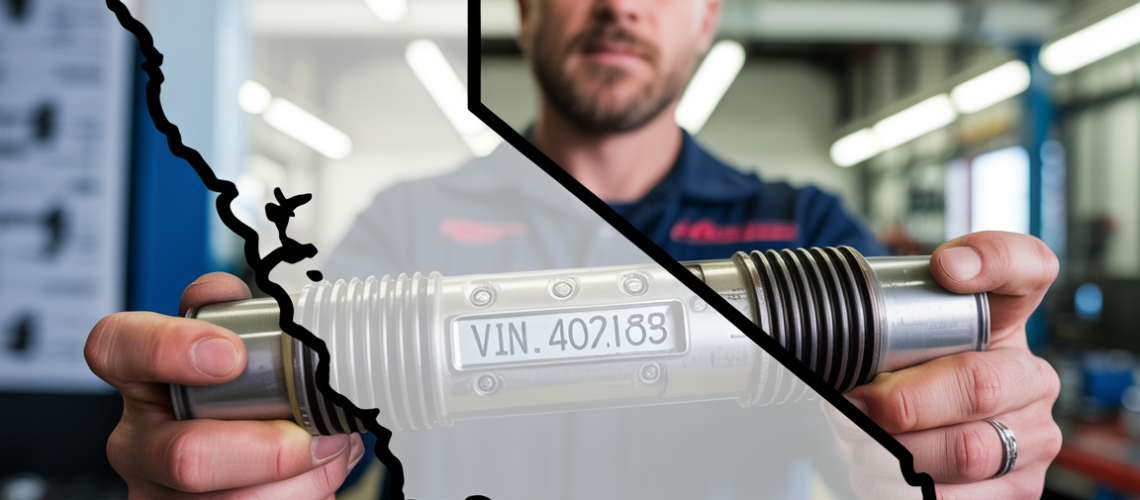
While AB 641 focused on who can hold converters, SB 55 focuses on the converters themselves. This legislation, also enacted in 2022 and fully enforced today, requires that every new and used vehicle sold in California must have its catalytic converter permanently marked with the vehicle’s VIN before the sale is completed, according to California Senate Bill 55.
According to California’s Department of Motor Vehicles official announcement, this VIN-marking requirement applies regardless of whether the converter is original equipment or an aftermarket replacement.
Marking Methods
SB 55 allows several approved methods for permanent VIN marking:
- Engraving or etching the VIN directly into the converter shell
- High-temperature paint markers with the VIN clearly visible
- Tamper-resistant labels designed to destroy themselves if removal is attempted (though these are less preferred by law enforcement)
The marking must be visible without removing the converter and must survive normal operating conditions, including heat, weather, and road debris.
When Marking Must Occur
The critical compliance point is this: VIN-marking must be completed before the vehicle is offered for sale or sold to a retail customer. This creates timing challenges for:
Dealers receiving trade-ins: If you accept a trade-in with an unmarked converter, you must have it marked before reselling the vehicle—even if the converter was factory-original. Many dealers are discovering this requirement only after wholesale buyers reject vehicles or retail customers complain.
Dealers purchasing wholesale inventory: Vehicles arriving from auctions or wholesale channels may not be marked. You cannot legally retail these vehicles until marking is completed, which adds an unexpected step to your reconditioning workflow.
Fleets disposing of units: When de-fleeting vehicles for resale (whether wholesale or retail), you must ensure converters are VIN-marked before the sale. This is particularly important for out-of-state fleet dispositions where the receiving dealer may not be aware of California’s requirements.
Documentation Requirements
Beyond physical marking, SB 55 requires dealers to maintain records showing:
- When the marking was performed
- Who performed the marking (technician or vendor)
- Method used (engraving, paint, etc.)
- Verification that the VIN matches the vehicle
These records must be retained and available for inspection by DMV, law enforcement, or the attorney general’s office. The law doesn’t specify an exact retention period, but best practice aligns with California’s general automotive records retention standards of at least three years.
Penalties for Non-Compliance
Selling a vehicle with an unmarked catalytic converter violates SB 55 and can result in:
- DMV complaints and investigations: Retail buyers who discover unmarked converters can file complaints, triggering dealer license reviews and potentially suspended registrations
- Attorney general enforcement: California’s AG has made catalytic converter enforcement a priority, with civil penalties available for violations
- Consumer lawsuits: Buyers may claim they purchased vehicles that don’t comply with California law, seeking rescission or damages
- Wholesale rejections: Auction houses and wholesale buyers increasingly reject vehicles with unmarked converters, forcing dealers to rework inventory or discount prices
Even if a vehicle’s converter was original equipment and never stolen, failure to mark it is still a violation once the vehicle enters your inventory for resale.
The Intersection of Converter Laws and DMV Registration
Here’s where these converter laws create serious DMV complications that many dealers and fleets don’t anticipate: converter issues can delay or block vehicle registration and title transfers.
Title Transfer Delays
When law enforcement conducts converter theft investigations, vehicles with unmarked or suspect converters can be flagged in DMV systems. If your customer attempts to register a vehicle you sold, and that vehicle is flagged, the registration can be held pending investigation.
This creates a nightmare scenario:
- You deliver the vehicle to the customer
- Customer attempts to register it
- DMV flags the VIN due to converter concerns
- Customer cannot complete registration and blames you
- You’re now managing an angry customer and a deal that’s technically not complete
Worse, if the investigation reveals the converter was stolen (even unknowingly), you may face repurchase demands, civil liability, and regulatory action.
Out-of-State Registration Complications
California’s converter laws apply to vehicles sold in California, but what happens when:
- You sell a California vehicle to an out-of-state buyer?
- A fleet de-fleets California-registered vehicles for resale elsewhere?
- An out-of-state dealer purchases inventory from California?
While other states may not have identical marking requirements, California law still requires compliance at the point of sale. If the converter isn’t marked when the vehicle leaves California, and it later returns or creates legal issues, you could still face liability.
Out-of-state registration services may reject California-titled vehicles without proper converter documentation, forcing rushed repairs or marking to complete vehicle registration transactions.
Salvage and Planned Non-Operation (PNO) Vehicles
Converter issues become even more complex with:
Salvage vehicles being rebuilt: If you’re rebuilding a salvage vehicle that requires converter replacement, the new converter must be VIN-marked, and you need documentation proving the replacement converter was legally sourced and properly documented.
PNO vehicles returning to operation: Vehicles held on Planned Non-Operation status that undergo repairs (including converter replacement) before re-registration must have proper converter marking and documentation before the PNO status can be lifted.
Reconstructed titles: Vehicles receiving reconstructed titles after significant repairs must demonstrate converter compliance as part of the reconstruction inspection process.
Attempting to register these vehicles without addressing converter documentation creates delays, requires additional inspections, and can trigger heightened scrutiny from DMV investigators.
Operational Compliance Checklist: What Dealers Must Do Now
California dealers need systematic procedures to ensure every vehicle in inventory complies with converter laws before sale. Here’s a practical implementation checklist:
Intake and Acquisition Procedures
For every vehicle entering inventory (trade-in, wholesale purchase, auction):
- [ ] Inspect converter presence immediately – Use a visual check or lift inspection
- [ ] Verify VIN marking – Confirm the converter is marked with the correct VIN using approved methods
- [ ] Document original converter status – Note whether converter is OEM, aftermarket, missing, or damaged
- [ ] Request prior repair records – If converter appears to be a replacement, get documentation showing the replacement was legal
- [ ] Flag unmarked units for reconditioning – Add converter marking to the recon checklist before moving vehicle to retail inventory
- [ ] Photograph converters – Take photos showing marking and condition for your records
Reconditioning and Preparation
Before moving vehicles to retail-ready status:
- [ ] Arrange VIN marking – Contract with a qualified technician or vendor to engrave/etch VINs on unmarked converters
- [ ] Verify marking quality – Ensure marking is legible, permanent, and matches vehicle VIN exactly
- [ ] Update vehicle records – Document date of marking, technician name, and method used
- [ ] Retain marking invoices – Keep all vendor invoices for marking services with the deal jacket
- [ ] Update inventory notes – Mark vehicles as “converter compliant” in your DMS
Vendor and Supplier Management
For any third-party services related to converters:
- [ ] Vet converter suppliers – Ensure replacement converters are from legitimate, documented sources
- [ ] Require marking services in recon contracts – Make VIN marking a standard deliverable from any reconditioning vendor
- [ ] Verify vendor compliance – Confirm vendors understand SB 55 requirements and use approved marking methods
- [ ] Document vendor relationships – Maintain records of all converter-related service providers for regulatory review
Sale and Delivery Documentation
Before completing any retail or wholesale sale:
- [ ] Confirm converter compliance – Verify marking is present and correct
- [ ] Add converter disclosure to buyer’s order – Consider adding a line item confirming “catalytic converter VIN-marked per California law”
- [ ] Retain compliance documentation – Store photos, marking receipts, and inspection notes with the deal jacket
- [ ] Provide converter documentation to buyer – Give customers copies of marking records (especially important for fleet buyers who may resell later)
Record Retention
Maintain comprehensive records for at least three years:
- [ ] Intake inspection photos and notes
- [ ] Marking service invoices and dates
- [ ] Vendor information and contracts
- [ ] Converter replacement receipts (if applicable)
- [ ] Customer disclosures and acknowledgments
These records are your defense if a converter-related complaint, investigation, or lawsuit arises after sale.
Operational Compliance Checklist: What Fleet Managers Must Do Now
Fleet operations face unique converter compliance challenges because you’re typically holding vehicles longer, performing maintenance in-house, and managing bulk dispositions. Here’s how to build converter compliance into your fleet management process:
Fleet Maintenance and Converter Replacement Procedures
For any in-house converter replacement:
- [ ] Log replacement before removal – Document which unit, date, mileage, and reason for replacement
- [ ] Photograph removed converter – Capture images showing marking (or lack thereof) and condition
- [ ] VIN-mark new converter immediately – Mark replacement converters with the unit’s VIN before installation
- [ ] Retain old converter with documentation – Store used converters with tags showing unit number, VIN, removal date
- [ ] Track converter inventory – Maintain a running log of how many loose converters are being held at any time (stay well under the three-converter threshold that triggers dismantler requirements)
- [ ] Dispose of cores promptly – Sell or recycle used converters quickly to minimize holding time and regulatory exposure
Fleet-Wide VIN Verification Program
Implement regular converter inspections across your fleet:
- [ ] Schedule annual converter checks – Include converter VIN verification in annual inspections or PM schedules
- [ ] Verify marking on newly acquired units – Check all incoming lease returns, purchases, or transfers for converter compliance
- [ ] Re-mark converters as needed – If marking has worn off or is illegible, have converters re-marked during service appointments
- [ ] Document inspection results – Keep logs showing date, unit number, inspector name, and marking status
Vendor and Service Provider Management
For outsourced maintenance or repairs:
- [ ] Include converter VIN-marking in SOWs – Make it a contractual requirement that all converter replacements include proper VIN marking
- [ ] Verify vendor compliance – Ensure third-party shops understand AB 641 and SB 55 requirements
- [ ] Require documentation – Demand invoices that specifically reference VIN marking and include photos/proof
- [ ] Audit vendor work – Periodically inspect vehicles serviced by outside vendors to confirm marking compliance
De-Fleet and Disposal Procedures
Before selling, donating, or disposing of fleet vehicles:
- [ ] Verify converter presence and marking – Ensure converters are present and VIN-marked before releasing vehicles
- [ ] Provide documentation to buyers – Give wholesale buyers or auction houses documentation showing converter compliance
- [ ] Disclose converter history – If a converter was replaced during fleet service, provide replacement documentation
- [ ] Photograph converters before disposition – Protect yourself by documenting converter condition and marking at time of sale
- [ ] Include converter status in sales contracts – Add language confirming “catalytic converter VIN-marked per California law” to protect against later disputes
Record Retention and Audit Trail
Maintain fleet-wide converter records:
- [ ] Converter replacement log – Track all replacements by date, unit, mileage, vendor, and new converter source
- [ ] VIN-marking documentation – Store photos and invoices proving when converters were marked
- [ ] Disposal records – Keep documentation for all used converter sales or recycling
- [ ] Annual inspection results – Retain logs showing fleet-wide converter verification
- [ ] Vendor contracts and SOWs – Maintain copies of service agreements requiring converter compliance
These records demonstrate that your fleet operation is proactive, compliant, and not operating as an unlicensed dismantler—critical protection if regulators come asking questions.
When Converter Problems Become Title or DMV Problems: The Quick Auto Tags Advantage
Catalytic converter compliance issues don’t just create operational headaches—they create DMV registration and title transfer nightmares that can derail deals, strand inventory, and trigger regulatory investigations. This is precisely where having an experienced DMV business partner becomes essential.
Quick Auto Tags helps California dealers and fleet managers navigate the registration and titling complexities that arise from converter-related issues through specialized services designed to handle complex scenarios:
1. Registration Hold and Investigation Management
When a vehicle is flagged by DMV or law enforcement due to converter concerns, the registration process doesn’t simply pause—it enters a complex investigation and verification workflow. Quick Auto Tags provides:
Investigation Coordination Support: Quick Auto Tags’ specialized dealer services maintain relationships with DMV investigation units and can help coordinate the documentation needed to clear converter-related flags, including:
- Submission of VIN-marking documentation and photos
- Coordination with law enforcement investigations
- Assembly of chain-of-custody records for replacement converters
- Liaison with DMV investigative staff to expedite clearance
Strategic Registration Timing: Quick Auto Tags can advise on the optimal timing for registration submission when converter repairs or marking are needed:
- Hold registration processing until converter compliance is verified
- Avoid triggering DMV flags by ensuring all documentation is perfect before first submission
- Coordinate registration with any ongoing theft investigations affecting the vehicle
This capability is crucial for dealers who’ve inadvertently accepted trade-ins or purchased wholesale vehicles with converter issues—you need the registration held and managed carefully while you remediate the problem.
2. Title Transfer Support for Vehicles with Converter History
Vehicles with documented converter replacements or theft history require extra care during title transfers. Quick Auto Tags provides:
Enhanced Documentation Assembly: When transferring titles for vehicles with converter-related complications, Quick Auto Tags helps:
- Compile complete converter replacement documentation
- Provide supplemental declarations explaining converter history
- Coordinate with DMV title units to ensure proper review and acceptance
- Manage title delays caused by converter investigations
Out-of-State Title Transfers: For vehicles being titled in California from out of state, or California vehicles being transferred out, Quick Auto Tags’ out-of-state registration expertise ensures:
- Proper documentation of converter compliance for interstate transfers
- Coordination with other states’ requirements
- Management of VIN verification processes that may uncover converter issues
- Resolution of title problems discovered during interstate transfer
These capabilities are particularly important for fleet managers disposing of California-registered units to out-of-state buyers, where converter documentation gaps can derail bulk sales.
3. Salvage, Rebuilt, and PNO Vehicle Registration Expertise
Vehicles undergoing significant repairs—including converter replacement—often need salvage certifications, rebuilt inspections, or PNO status management. Quick Auto Tags specializes in:
Salvage and Rebuilt Vehicle Registration: For vehicles requiring new converters after theft or damage:
- Coordination of brake and light inspections that now verify converter VIN-marking
- Assembly of repair documentation showing legally sourced replacement converters
- Management of DMV’s heightened scrutiny on rebuilt vehicles with converter replacements
- Expedited processing to minimize holding costs
Planned Non-Operation (PNO) Services: When vehicles held on PNO status undergo converter repairs:
- Proper documentation of repairs before PNO lift
- Verification that converter marking is complete before re-registration
- Coordination of PNO-to-active registration transitions without triggering flags
VIN Verification and Inspection Coordination: Quick Auto Tags can arrange and manage VIN verifications that specifically address converter presence and marking—critical for vehicles with complex histories or those returning from out of state.
4. Fleet Registration and Converter Compliance Documentation
For fleet managers dealing with converter issues across multiple units, Quick Auto Tags’ comprehensive fleet services provide systematic solutions:
Permanent Fleet Registration (PFR) for Qualifying Vehicles: Fleets that qualify for PFR may face simplified converter documentation requirements for certain commercial vehicles. Quick Auto Tags provides:
- Evaluation of which units qualify for PFR treatment
- Coordination of fleet-wide registrations with consistent converter documentation
- Management of mixed fleets where some units require full converter compliance while others follow PFR rules
Bulk Registration with Converter Documentation: For fleets managing large-scale registrations, Quick Auto Tags ensures:
- Consistent converter documentation across all units
- Systematic verification that all vehicles meet VIN-marking requirements before registration
- Efficient processing even when some units require additional converter documentation
- Protection against fleet-wide registration delays due to converter issues on individual units
Interstate Fleet Registration Coordination: For fleets operating in multiple states, Quick Auto Tags manages:
- California-to-other-state registrations with proper converter documentation
- Other-state-to-California registrations ensuring converters meet California marking requirements
- Resolution of converter compliance questions that arise during interstate fleet moves
5. Proactive Registration Compliance Audits
Quick Auto Tags can help dealers and fleet managers avoid converter-related registration problems before they happen through:
Pre-Registration Compliance Reviews: Before submitting registration paperwork, Quick Auto Tags can:
- Review vehicle history for converter-related flags or investigations
- Identify documentation gaps that may trigger DMV delays
- Recommend additional documentation to support clean registration processing
- Flag vehicles requiring VIN verification or inspection before registration
Registration Readiness Consultations: For high-volume dealers or fleets with complex inventory, Quick Auto Tags provides:
- Training on converter-related registration issues
- Standard operating procedures for converter documentation
- Integration with your existing recon or maintenance workflows
- Ongoing compliance monitoring and updates as laws evolve
This proactive approach prevents the “surprise” registration hold that happens when a dealer or fleet manager submits paperwork for a vehicle without realizing it has converter compliance issues.
6. Rapid Problem Resolution When Issues Arise
Despite best efforts, converter issues sometimes surface after registration is already underway. Quick Auto Tags provides rapid response:
Registration Withdrawal and Correction: If a converter issue surfaces after registration submission:
- Coordinate withdrawal of pending registrations before they’re fully processed
- Assemble corrective documentation
- Re-submit registrations with proper converter documentation
Temporary Registration Support: When investigations or documentation delays prevent normal registration:
- Arrange temporary operating permits to keep vehicles in use or saleable
- Manage temporary registration renewals during extended investigations
- Coordinate final registration once converter issues are resolved
DMV Complaint and Investigation Liaison: If a customer files a DMV complaint about a converter issue:
- Coordinate dealer or fleet response to DMV
- Assemble documentation showing good-faith compliance efforts
- Work with DMV investigators to resolve complaints without license sanctions
This rapid-response capability minimizes the damage when converter issues threaten to derail deals or disrupt fleet operations.
Why Converter Compliance Is a Registration Strategy, Not Just a Parts Issue
Many dealers and fleet managers initially view catalytic converter compliance as a reconditioning or maintenance task—just another box to check before sale or service. But California’s AB 641 and SB 55 have made converter compliance a critical registration and title management issue that directly impacts your ability to complete deals and maintain clean DMV records.
Here’s why:
DMV is now a front-line enforcer: California DMV actively participates in converter theft investigations and can flag vehicles in registration systems, triggering holds, investigations, and potential dealer license actions. Your converter compliance problems become registration problems instantly.
Converter issues delay or prevent title transfers: You can have a perfect deal on paper, but if the converter isn’t marked or is suspected of theft, the registration won’t complete. The customer blames you, lenders get nervous, and deals fall apart.
Investigation timelines are unpredictable: When a vehicle is flagged for converter issues, resolution timelines are often outside your control. Law enforcement and DMV investigations can take weeks or months, during which the vehicle is essentially unsaleable and un-registrable.
Liability extends beyond the initial sale: If a vehicle you sold later triggers converter theft investigations—even years later—you can face repurchase demands, civil suits, and DMV complaints. Proper documentation at the time of sale is your only defense.
Registration partners become essential risk managers: Having a DMV business partner who understands converter laws and can proactively manage registration documentation becomes a competitive advantage. Dealers and fleets who handle their own DMV paperwork are increasingly getting caught by converter-related registration traps they didn’t see coming.
This is why Quick Auto Tags’ role in converter compliance goes far beyond simply processing registrations. We help you anticipate converter-related registration issues, manage documentation to avoid flags, coordinate with DMV when issues arise, and keep deals moving even when converter complications surface.
Real-World Scenario: How Converter Issues Derail Deals (And How Quick Auto Tags Helps)
The Problem:
A California independent dealer accepts a 2019 Honda Accord as a trade-in. The vehicle has 68,000 miles, runs perfectly, and appears to be in excellent condition. The dealer performs basic recon—detailing, safety check, minor repairs—and lists the vehicle for retail sale.
Three weeks later, a buyer agrees to purchase the Accord. The dealer completes the sale, delivers the vehicle, and the buyer attempts to register it at DMV. During the registration process, DMV flags the VIN—the vehicle was reported stolen two years ago after the original owner’s catalytic converter was stolen and the vehicle was recovered. The report was closed, but it remains in the system.
Now DMV requires additional documentation proving the current converter is legally installed and properly marked. The dealer wasn’t aware of the theft history, never checked the converter marking during recon, and has no documentation about the current converter’s source.
The buyer is furious—they can’t register the vehicle. The dealer is stuck with an angry customer, a deal in limbo, and no clear path to resolution. The finance company won’t fund the loan until registration is complete. The whole transaction is collapsing.
How Quick Auto Tags Solves This:
- Immediate Registration Hold: Quick Auto Tags puts a hold on any further registration attempts to prevent additional flags or complications.
- Documentation Assembly: Quick Auto Tags works with the dealer to:
- Inspect and photograph the current converter and its VIN marking
- Obtain declarations from the previous owner (the trade-in customer) about converter replacement history
- Coordinate with the repair shop that replaced the original stolen converter (if documented)
- Assemble a complete chain-of-custody package for DMV review
- DMV Investigation Coordination: Quick Auto Tags contacts DMV’s investigation unit, explains the situation, and submits the documentation package with a request to clear the flag.
- Temporary Registration Solution: While the investigation is pending, Quick Auto Tags arranges a temporary operating permit so the buyer can legally drive the vehicle.
- Final Registration Completion: Once DMV clears the flag, Quick Auto Tags processes the final registration, issues permanent plates and stickers, and the deal closes successfully.
Total resolution time: 12 business days instead of the 6-8 weeks it would have taken if the dealer tried to handle it alone (or the deal potentially falling apart entirely).
The lesson: Converter issues are registration issues, and having an experienced DMV partner who can navigate these complications is no longer optional for California dealers and fleet managers.
Building a Sustainable Converter Compliance Program: The Quick Auto Tags Partnership
California’s catalytic converter laws aren’t going away—they’re going to get stricter as law enforcement and regulators refine their enforcement strategies. Dealers and fleet managers need systematic, sustainable approaches to converter compliance that integrate with registration and title management workflows.
This is where the right DMV business partner transforms from a transaction processor into a strategic compliance advisor.
Quick Auto Tags offers California dealers and fleet managers a comprehensive converter compliance and registration management framework:
Integrated Compliance Consulting
Quick Auto Tags provides:
- Quarterly compliance reviews to ensure your intake, recon, and disposition procedures align with current AB 641 and SB 55 requirements
- Staff training sessions covering converter documentation, VIN marking, and registration implications
- Standard operating procedure development that integrates converter compliance into your existing workflows
- Vendor management support to help you select and monitor marking service providers
Technology-Enabled Documentation Management
Quick Auto Tags’ systems allow:
- Digital documentation storage of converter photos, marking invoices, and compliance records linked to each vehicle
- Registration status tracking showing which vehicles are clear for registration and which require additional converter documentation
- Alert systems that flag vehicles with potential converter issues before registration is submitted
- Audit trails proving compliance if regulatory reviews or customer complaints arise
Dedicated DMV Liaison and Investigation Support
Quick Auto Tags provides:
- Direct communication channels with DMV investigation units and title sections
- Expedited processing of converter-related registration holds
- Documentation assembly expertise that ensures you submit exactly what DMV needs the first time
- Investigative coordination when converter theft reports or flags impact your inventory
Regulatory Updates and Proactive Alerts
Quick Auto Tags monitors:
- New legislation and regulatory guidance affecting converter compliance
- DMV policy changes related to converter documentation requirements
- Law enforcement priorities and enforcement trends
- Case law and regulatory enforcement actions that establish new compliance standards
You receive regular updates so you’re never caught off-guard by changing requirements.
Converter Compliance Action Plan: Implement These Steps This Month
California dealers and fleet managers who implement systematic converter compliance programs now will avoid registration disasters, regulatory enforcement, and costly deal failures down the road. Here’s your 30-day action plan:
Week 1: Assess Current State
- [ ] Review the last 30 vehicles entering inventory—how many have documented, verified converter VIN marking?
- [ ] Check your reconditioning checklists—is converter VIN verification a required step?
- [ ] Audit your current inventory—how many vehicles are retail-ready but lack confirmed converter VIN marking?
- [ ] Review your record retention—do you have documentation for converter status on vehicles sold in the past 12 months?
Week 2: Implement Intake Procedures
- [ ] Add “Converter Presence and VIN Marking Verification” to all acquisition inspection forms
- [ ] Train intake staff on what proper VIN marking looks like and how to photograph converters
- [ ] Establish a protocol for flagging vehicles needing converter marking during recon
- [ ] Create a simple log tracking vehicles with converter issues and their remediation status
Week 3: Update Vendor Relationships and Recon Workflows
- [ ] Contact your reconditioning vendors and add VIN marking to standard service requirements
- [ ] Verify vendors understand AB 641 and SB 55 and use compliant marking methods
- [ ] Add “Converter Compliance Verified” as a gate before moving vehicles to retail-ready status
- [ ] Update deal jacket checklists to require converter documentation before delivery
Week 4: Establish Registration and DMV Coordination
- [ ] Contact Quick Auto Tags to discuss converter compliance integration with your registration workflow
- [ ] Review recent registration delays or DMV holds—were any related to converter issues?
- [ ] Implement pre-submission reviews with Quick Auto Tags for vehicles with converter replacements or unclear histories
- [ ] Establish a rapid-response protocol for converter-related registration problems
Ongoing: Monitor, Document, and Refine
- [ ] Conduct monthly audits of converter compliance across new inventory
- [ ] Review registration processing times and flag any delays potentially related to converters
- [ ] Update procedures as Quick Auto Tags alerts you to new regulatory requirements or enforcement trends
- [ ] Maintain comprehensive records for all converter-related documentation
This systematic approach protects you from liability, keeps deals moving, and ensures every vehicle you sell or de-fleet has clean registration and title documentation.
The Bottom Line: Converter Compliance Is Registration Insurance
California’s catalytic converter laws have fundamentally changed the risk profile of vehicle acquisition, reconditioning, fleet maintenance, and resale. What was once a minor parts-replacement issue has become a potential trigger for DMV investigations, registration holds, customer complaints, and regulatory enforcement.
Dealers who continue treating converter compliance as an afterthought—or who assume “someone else” handled it before the vehicle reached their lot—are setting themselves up for registration disasters that derail deals and damage their reputations.
Fleet managers who don’t systematically track converter replacements, VIN marking, and disposal documentation are risking classification as unlicensed automobile dismantlers, with criminal penalties and license sanctions on the line.
The good news: With proper procedures, documentation, and the right DMV business partner, converter compliance becomes manageable, systematic, and integrated into normal operations. You protect yourself from liability, keep registrations moving, and ensure every deal closes cleanly.
Quick Auto Tags specializes in helping California dealers and fleet managers navigate the registration and title implications of catalytic converter compliance. Our team understands how converter issues intersect with DMV processes, and we have the relationships and expertise to resolve problems quickly when they arise.
Don’t wait until a converter-related registration hold costs you a deal, triggers a DMV investigation, or creates an angry customer demanding refunds. Build converter compliance into your operations now, with Quick Auto Tags as your registration and title management partner.
Ready to protect your dealership or fleet from converter-related registration disasters?
Contact Quick Auto Tags today to discuss:
- How to integrate converter compliance into your registration workflows
- Pre-submission compliance reviews for vehicles with converter issues
- Rapid response services when converter problems arise during registration
- Fleet-wide converter documentation audits and management
Your next vehicle acquisition could have hidden converter issues waiting to become registration nightmares. Let Quick Auto Tags help you identify and resolve them before they cost you time, money, and deals.
California Catalytic Converter Law Quick Reference
| Law | Key Requirement | Who It Affects | Penalty for Non-Compliance |
|---|---|---|---|
| AB 641 | Holding 3+ loose converters may require automobile dismantler license | Dealers, fleets, shops holding multiple converters | Criminal penalties, fines up to $1,000+, license suspension |
| SB 55 | All converters must be VIN-marked before vehicle sale | All dealers and sellers | Civil liability, DMV complaints, consumer lawsuits |
| Documentation Requirements | Records proving legal converter source and marking | Dealers, fleets, anyone replacing converters | Inability to prove compliance during investigations |
About Quick Auto Tags
Quick Auto Tags is a California DMV-authorized business partner providing comprehensive registration, titling, and fleet services to dealerships, fleet managers, and vehicle owners throughout the state. With specialized expertise in complex registration scenarios—including salvage/rebuilt vehicles, out-of-state transfers, and compliance-sensitive transactions—Quick Auto Tags helps California automotive businesses navigate regulatory requirements while maintaining fast, accurate processing.
Authoritative Sources:
- California Legislature – Assembly Bill 641 (Automobile Dismantlers: Catalytic Converters)
- California Legislature – Senate Bill 55 (Vehicles: Catalytic Converters)
- California DMV – New Laws in 2024 (Official Announcement)
- Telesis Marking – California’s Anti-Theft Laws for Dealerships
- Madison Law APC – CA Passes Bill Aimed At Reducing Catalytic Converter Theft
- Catalytic Converter Protection – State Laws Comprehensive Guide
Last Updated: February 2026
